




 +49 40 401 161-079
 info@battery-kutter.com
Concrete has long been a core component of our urban landscape, but soon it could serve not only as a building material, but also as a giant battery. The combination of cement, water, ultra-fine carbon black (with particles in the nanometre range) and electrolytes creates electron-conducting carbon concrete (ec³), which can form a conductive ‘nano network’ inside the concrete.
Such a network would enable walls, pavements and bridges to store and release electrical energy and withstand tens of thousands of charging cycles. The electrolyte used for the technology can even be flexibly selected. Even seawater could be used, enabling applications near the coast or on offshore installations. With over 10,000 documented charging cycles without any significant loss of performance, the storage capacity would also be compatible with the usual service life of concrete structures of around 50 years.
Rapid developments in research
How is this possible? MIT researchers Franz-Josef Ulm and Admir Masic have achieved a breakthrough in their research, increasing the storage capacity of concrete almost tenfold in just one year. Previously, around 45 cubic metres of concrete were needed to store the daily electricity requirements of an average household, but now around 5 cubic metres are sufficient – the volume of a single basement wall. The new generation of ec³ technology thus achieves storage densities of over 2 kWh per cubic metre. A concrete block the size of a refrigerator stores around 0.6 kWh and could therefore reliably power one for around two days.
Vision for the future: car parks as energy storage facilities for e-mobility
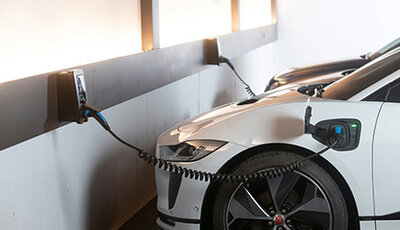
International trade media outlets are outlining a possible future scenario in which car parks will serve as decentralised storage facilities for renewable energies. During the day, photovoltaic systems on the roof could generate energy and store it in the conductive concrete structure; at night, this energy would then be transferred to parked electric vehicles. A parking space with around 3.75 cubic metres of storage concrete could theoretically supply around 7.5 kWh – enough for a range of around 30 to 50 kilometres.
However, there are currently no concrete applications for electric vehicles. The expected charging capacity is only 1-2 kW for the time being, which corresponds to so-called Level 1 charging. It would take 8-10 hours to fully charge an electric car – modern fast-charging infrastructure currently provides 50-350 kW. In addition, important components such as power electronics for voltage conversion from 12 volts (concrete) to 400-800 volts (vehicle battery) are currently still missing.
Japan is already implementing its first projects
In Japan, the technology is already being tested in practice: the company Aizawa Concrete is collaborating with MIT. In Sapporo, researchers are testing special concrete slabs that can heat themselves to melt snow – a realistic application in a region that experiences up to five metres of snowfall annually.
Interesting side effect: structural self-monitoring
The researchers at MIT also discovered that the conductive storage concrete reacts to mechanical stress with measurable changes in electrical voltage. This means that the technology could even serve as an integrated sensor in the future: for example, bridges would be able to continuously monitor their own stability, and the foundations of wind turbines could provide early warning of overloads. The material thus combines three functions in one: supporting structure, energy storage and sensor element.
Sources: wattmoves.de, Christian Schindler, 10.10.2025
news.mit.edu, Andrew Paul Laurent, 01.10.2025
Image: smart-me AG on Unsplash